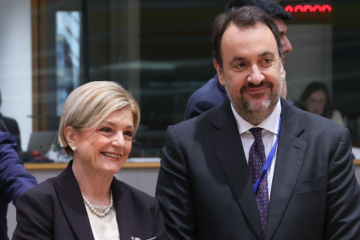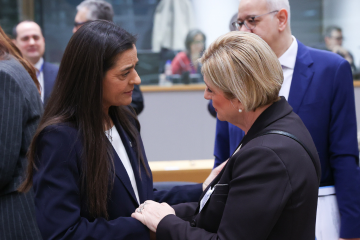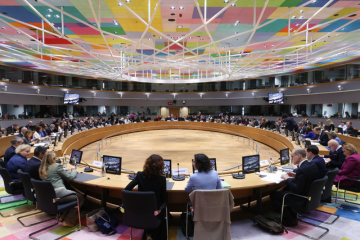
Gender equality is of the essence in a strong and healthy society. Today's meeting of the EPSCO Employment and Social Affairs Council which took place in Brussels today opened with a call for the need to remove barriers to women's participation, not least in order to reduce poverty. The EPSCO Council meeting, the first under the Cypriot Presidency, was attended by the Executive Vice-President of the European Commission, Roxana Minzatu, and the Commissioner for Energy and Housing, Dan Jørgensen. Italy was represented by the Minister for Labour and Social Policies, Marina Calderone.
The Council, by introducing a package of measures related to the European Semester that concern certain social and employment aspects and the promotion of human capital in the European Union, has focused on three areas in particular: the poverty cycle and how it can be broken; quality jobs and the implementation of artificial intelligence; and housing solutions.
Minister Calderone spoke about the Italian government's reforms designed to promote the full social inclusion of vulnerable individuals and families, focusing on their integration into the world of labour, partly to be achieved by strengthening digital services and tools, thus promoting greater synergies between social services and employment services. The Council's attention was drawn to the digital platform for social and labour integration services (SIISL), the recruitment of new staff in Social Territorial Areas (integrated local social networks), structured around multidisciplinary teams backed by national and European resources, and the adoption of preventive measures to address situations of disadvantage affecting children and adolescents in collaboration with social economy organisations. "The key to the success of the future European Strategy against Poverty lies in the ability to promote integrated social investment policies," said Minister Calderone in her speech, recalling the need to focus on the needs and skill gaps of individuals and households. "Investments in this area are not only tools promoting inclusion: they are a structural factor that affects long-term competitiveness because they strengthen human capital, participation and social trust. We must combine growth, dignity and cohesion. Italy is ready to actively contribute to this shared vision".
During the day, representatives of the European Union member states also discussed the use of AI to strengthen quality employment and workers' rights. In this context, Minister Calderone presented the Italian National Strategy, calling for the European Semester to maintain a strong focus on skills and support Member States in coordinating a synergistic and integrated response to the challenges posed by AI. With a view to the approval of the Quality Jobs Act, the Minister suggested “strengthening exchanges and cooperation between Member States, also drawing on the experience of the National Observatories on AI and Labour, already set up in some of our countries”. Jean-Pierre Farandou, French Minister of Labour, Employment and Integration, and Michael Schäfer, German State Secretary for Labour and Social Affairs, expressed similar views. European Commission Vice-President Minzatu, referring to the conversations on the subject held during the event dedicated to AI and labour held in Rome on 27 February, emphasized that the Observatories and platforms presented by member countries will be valuable sources of information to help understand the impact of AI-driven transformations in the world of labour. For this reason, the European Commission intends to continue discussing coordination between the various Observatories.