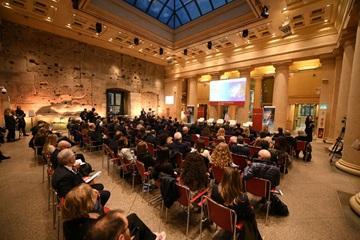
"AI and Work: Managing transformation, Multiplying Opportunities" was the theme of today's work which took place at the Tempio di Vibia Sabina e Adriano, headquarters of the Rome Chamber of Commerce, as well as at the INPS and INAIL headquarters at Palazzo Wedekind and Palazzo Brasini, respectively. The Ministry of Labour and Social Policies supported the event in association with the National Social Security Institute and the National Institute for Insurance against Accidents at Work.
The initiative brought together representatives from the Italian government, the European Commission, the French and German governments, the European Parliament, international organisations, social partners, businesses and the research community to discuss the transformations generated by artificial intelligence in the workplace as well as the governance tools needed to ensure development, protection and inclusion.
Prime Minister Giorgia Meloni opened the proceedings with a message describing AI as "the most disruptive revolution of our time, a technology that can unleash its full positive potential only if its development is guided by ethical rules that give priority to people, their rights, and their needs." Meloni said that Italy was among the first countries to adopt a national law establishing an Observatory to monitor the adoption of AI in the workplace and based at the Ministry of Labour. She identified three areas of action: skills training, quality of work, and governance.
The importance of European synergy emerged at the conference. "We face common issues, and we agree that the approach to using artificial intelligence at the workplace should be human-centred" said Marina Calderone, the Minister of Labour and Social Policies. "Our strategy prioritises people by establishing a connection between job support, continuing education, and worker retraining." Minister Calderone reiterated the approach outlined during the Italian G7 presidency, with AI being used to promote people's ability to work better, and summarised the integrated ecosystem built up over the past three years to govern the digital transition: the Observatory to monitor the adoption of AI in the workplace which has monitoring and ethical guidance functions; the SIISL platform to match skills and opportunities; EDO as an enabling digital infrastructure; and AppLI, the web coach that uses multi-generative AI for guidance and assisted training.
Minister Calderone, Executive Vice-President of the European Commission Roxana Minzatu, and German Secretary of State for Labour Michael Schäfer discussed the importance of supranational cooperation and the will to pursue a unified European approach. There was also a focus on competitiveness, the resilience of the European social system, fair mobility for workers, and digitalisation of social security systems.
Event materials and panel recordings are available here. For further information, please read the pre-event press release from the Ministry of Labour and Social Policies.